Site Title✦ ADHD | Autism | Emotional Processing | Trauma Healing ✦

Where neurodivergent minds take flight and sensitive hearts adapt.

  • There are some days as a father that don’t look like anything special from the outside.

    No medals.

    No milestones.

    No perfect Instagram pictures.

    Just a garage,

    a stubborn old dirt bike,

    and a boy who thinks the world of his dad.

    Yesterday, my son and I spent the whole day

    trying to get his 1990 Honda XR80R running.

    Two trips to the store.

    Twenty times tearing down the carburetor.

    Gas-streaked hands, scraped knuckles,

    and a whole lot of,

    “Okay, let’s try again.”

    We didn’t fix it.

    The engine wouldn’t start.

    But here’s the thing:

    that wasn’t the point.

    In our world — what we call our play bubble —

    I am Big Back.

    That’s what he calls me,

    because I’m the one he leans on,

    the one he knows will carry him,

    not just in the garage,

    but through the hard, silent, unseen moments of life.

    Like when we shaved our heads together this summer.

    For me, it was routine.

    For him, it was adventure.

    At first, we laughed,

    two matching bald heads in the mirror.

    But then came the stares.

    Then came the regret.

    And one day, softly from the backseat,

    he asked,

    “Dad… can you take off your hat?”

    I understood.

    Now, when we go out,

    I leave the hat at home.

    Not because he needs to ask.

    Because I want him to know:

    “You’re not alone in this.

    I will stand beside you, bare-headed, shoulders wide.

    Big Back has got you.”

    But it’s not just the hair.

    And it’s not just the dirt bike.

    It’s the back scratches.

    Every night, every afternoon,

    he asks,

    “Dad, can you scratch my back?”

    Not because it’s itchy.

    But because that’s how he calms.

    That’s how his nervous system settles.

    That’s how he knows,

    without words,

    that he is safe.

    My hands on his back tell him what the world can’t:

    “I am here.

    You are held.

    You are home.”

    We didn’t fix the dirt bike.

    We didn’t escape the stares.

    We didn’t make the world softer.

    But we did this:

    We showed up.

    We stood beside each other.

    We scratched each other’s backs,

    in the way only a father and son in a broken, beautiful world can.

    🌿 To my son:

    You are the best thing I have ever been part of building —

    more than any engine,

    more than any project,

    more than any version of myself I thought I had to become.

    You don’t have to be unafraid.

    You don’t have to be unscarred.

    You don’t have to walk alone.

    Big Back’s got you.

    Bare-headed.

    Knuckles scraped.

    Heart wide open.

    Always.

    💛 **For you son, forever.

    From Big Back.**

  • By Kevin | BrainButterfly.org

    We crave Lego.

    Furniture assembly.

    Construction.

    Definitive rights and wrongs.

    Not because we’re rigid.

    Not because we’re simple.

    But because in a world that constantly betrays our senses,

    we long for something tangible —

    something where the rules hold,

    where patterns stay,

    where right and wrong are knowable.

    But here’s the other thing you need to know:

    We don’t shy away from the wrongs.

    We embrace the wrongs.

    Because without the wrongs,

    we never know the rights.

    Without the failures,

    we never learn the shape of success.

    We know what it is to miss.

    To stumble.

    To screw it up a hundred times before it clicks.

    But we also know:

    You will forever miss every shot you don’t take.

    Don’t let the fear of striking out keep you from swinging the bat.

    This is the heartbeat of the neurodivergent mind:

    building, breaking, learning, swinging, missing, trying again.

    Not because we’re fearless —

    but because we are wired to survive through the rebuild.

    © 2025 Kevin Sarasin | BrainButterfly™ & ADHDChildFund™

    brainbutterfly.org

  • By Kevin | BrainButterfly.org

    Founder, BrainButterfly™ & ADHDChildFund™

    Let’s talk about English.

    Specifically: who invented this language, and why did they clearly despise neurodivergent people.

    “I before E, except after C.”

    Great. Thanks.

    Except for:

    weird height neighbor foreign their science

    OH. So basically:

    “Here’s a rule. Just kidding — the rule doesn’t work.”

    Let’s keep going, shall we?

    Silent letters: knee, knife, knock. Why? WHY. Words that look the same, sound different: read / read, lead / lead, wind / wind. Words that sound the same, mean different things: there, their, they’re. to, too, two. pair, pare, pear.

    My neurodivergent brain: “Error 404. Logic not found.”

    And then you get punished for not “sounding it out.”

    You’re sitting there, a kid in school,

    sensory system overloaded,

    nervous system on high alert,

    and they’re like:

    “Sound it out! Just follow the rules!”

    Buddy, THE RULES DON’T EVEN FOLLOW THE RULES.

    No wonder half of us ran straight for math, science, or assembly instructions —

    anywhere the pattern held.

    Give me a LEGO manual over Shakespeare ANY DAY.

    But here’s the kicker:

    We may laugh at it now, but it broke some of us back then.

    It told us we were lazy, dumb, or slow —

    when in reality, our brains were just too sharp

    to tolerate nonsense.

    We crave:

    ✅ patterns,

    ✅ clarity,

    ✅ definitive rights and wrongs.

    And when the system offers us none of that?

    We rebel.

    We shut down.

    We make jokes like:

    “Who invented this language — some drunken neurotypical?” (lol, I joke… kind of).

    Final truth?

    We’re not broken for struggling with this system.

    We’re brilliant for surviving it.

    So to all my fellow neurodivergent thinkers:

    You are not stupid.

    You are not lazy.

    You are a survivor of bad design.

    And I am with you, laughing, ranting, rebuilding, and breaking the cycle. 💥🌀

    © 2025 Kevin Sarasin | BrainButterfly™ & ADHDChildFund™

    brainbutterfly.org

  • By Kevin | BrainButterfly.org

    I’ve been thinking about why I — and so many like me — have resisted literature our whole lives.

    Not because we’re unintelligent.

    Not because we’re lazy.

    Not because we’re uninterested.

    But because the systems of language have betrayed us.

    We were punished for not being able to “sound it out” when learning to read.

    We were shamed for struggling with the English language — a system so packed with contradictions, it mocked our logical, literal, sensory-driven brains.

    There. Their. They’re.

    Three words, three meanings, three spellings, one sound.

    Knife. Knew. Knock.

    A silent K? Why?

    Our nervous systems could not reconcile it.

    We gravitated to math, science, facts —

    to worlds where truths were undeniable, where patterns held, where 2+2 was always 4.

    Because literature was not just story.

    It was betrayal.

    It was being asked to enter a space where our senses and logic collapsed, and where our “failure” was named as laziness or stupidity — when really, it was survival.

    For some neurodivergent minds,

    literature wasn’t a playground.

    It was a battlefield.

    And many of us left the field to survive.

    So if you wonder why we resist fiction, metaphor, “imagination play,”

    it’s not because we’re cold or rigid or small-minded.

    It’s because we’ve been punished by the very systems that claimed to hold beauty.

    And we ran toward the things that stayed solid, sure, and safe.

    © 2025 Kevin Sarasin | BrainButterfly™ & ADHDChildFund™

    brainbutterfly.org

  • ✨ Calm Was My Weapon of Choice: A Neurodivergent Father’s Story

    By Kevin | BrainButterfly.org

    On July 11, 2025, I stood at the Brantford Courthouse, papers in hand, my 7-year-old son at my side. We weren’t there just to file an affidavit — we were there to protect his rights, to seek justice after someone we trusted crossed a line.

    As a father and as someone with ADHD, I knew walking in that this wasn’t just paperwork. It was emotional labor. But what I didn’t expect was that our biggest battle would be for basic respect.

    I approached the counter calmly. I asked, politely, if I was doing it right. And almost immediately, I felt it — the shift, the dismissal, the resistance. Her tone turned cold, her words clipped, her patience gone.

    I told her softly, “So just so you know, I have ADHD, so I process things a little bit differently.”

    Her answer? “Yeah, I’m aware. I’m quite aware of ADHD.”

    When I explained that my son and I were feeling triggered by her tone, she replied, “I can’t talk to you any other way, sir.”

    And then she was done with me.

    Both my fight and flight were triggered at the same time.

    My nervous system wasn’t just tense — it was stuck in the hurricane.

    But this time, I wasn’t alone.

    I had one of my superheroes beside me: my son.

    We stood there, father and son, two neurodivergent souls weathering the storm, asking calmly to be seen and heard.

    And here’s the truth: calm was my weapon of choice.

    I didn’t raise my voice. I didn’t storm out. I stayed. And in the end, it wasn’t me who escalated — it was her.

    When another clerk stepped in — calm, kind, patient — everything changed. We completed the process smoothly, no anger, no incident, just humanity.

    This isn’t just my story. It’s the story of every neurodivergent person who stays calm, explains themselves, and still gets dismissed.

    It’s the story of kids like mine, who are learning too early what it means to be misunderstood — and what it takes to survive in systems that were never built for their minds or hearts.

    That’s why I founded BrainButterfly.org, ADHD Child Fund™, and Heather’s Haven — because we shouldn’t have to fight twice: once against the system, and once to prove we’re worthy of dignity.

    If you’ve been here, I see you.

    You’re not alone.

    And calm is still your power. 💛

  • By Kevin | BrainButterfly.org

    Learning to Parent the Child Who Thinks They Have to Earn Your Love

    The other day, my child said something that stopped me in my tracks:

    “I don’t want to disappoint you out of fear. And I know you expect me not just to try, but to do it.”

    No attitude.

    No excuses.

    Just honesty — soft, raw, and vulnerable.

    At first, I felt a pang of guilt. That’s not the parent I want to be.

    But then I realized — this wasn’t a criticism.

    It was a gift.

    A rare window into how I’m experienced, not just how I see myself.

    Belief vs. Pressure

    I believe in my child deeply.

    I see them — how smart, sensitive, and capable they are.

    Sometimes, because I see so much light in them, I expect a lot.

    But they took that belief and turned it into pressure.

    They thought that trying wasn’t enough — that I needed them to succeed.

    Not because I punished. Not because I was harsh.

    But because neurodivergent kids feel everything more intensely.

    They interpret disappointment as failure.

    They turn expectations into heavy emotional weight.

    Rewriting the Message

    So I said the words they needed to hear — the words I wish I’d said sooner:

    “I love you no matter what — whether you do the thing or not.

    I’m proud of you for who you are, not just what you do.

    You don’t have to earn that from me.

    You already have it. Trying is enough. Asking is always okay.”

    That’s the message I want stitched into their nervous system.

    Not “be strong.”

    Not “figure it out.”

    Not “you’ve got this.”

    But “you’re already enough — right now.”

    For the Kids Who Feel Too Much

    This is for every child who’s ever felt they had to perform to be loved.

    Who took a parent’s belief in them and turned it into quiet fear.

    We can still believe in our kids. We should.

    But we have to remind them — again and again —

    that we love them, not for the things they do,

    but for who they are when they’re tired, messy, scared, or still learning.

    🦋 Because no matter how itty bitty their butterfly brain might feel in a world full of noise… to me, it’s the biggest thing there is.

  • 🔌 The Edison Gene: Why ADHD Isn’t a Disorder — It’s a Leadership Code

    By Kevin | BrainButterfly.org

    “We’re born leaders. We’re not wired to follow. We think for ourselves.”

    That’s not dysfunction. That’s design.

    When people think of ADHD, they usually think of:

    Chaos Disruption Trouble

    A label stamped onto a child’s file to explain why they don’t sit still, why they question everything, why they can’t fit the mold.

    But here’s the truth — some of us weren’t built to fit molds.

    Some of us were built to break them.

    And that’s where the Edison Gene comes in.

    💡 What Is the Edison Gene?

    Coined by author Thom Hartmann, the “Edison Gene” is based on the idea that some children — like Thomas Edison — are hardwired for innovation, leadership, and unconventional thinking.

    They aren’t broken.

    They’re brilliant — but only if they’re seen for who they really are.

    These are the kids who:

    Build with what they have, not what they’re told to use Ask “why?” when others say “because I said so” Dream big, feel deeply, move fast Can’t be tamed by quiet classrooms or one-size-fits-all systems

    Sound familiar?

    That’s exactly what both of my sons embody.

    👦 My Sons Have the Edison Gene

    They’re bright.

    They’re intense.

    They’re wild and wise in ways the world doesn’t always understand.

    They’re both neurodivergent. They’ve been failed by institutions meant to protect them.

    But they continue to lead — not because they’re told to, but because they were born to.

    One of them says with full sparkle and pride:

    “Who has two thumbs and loves hockey? THIS guy.”

    The other carries a quiet fire, asking deep questions and observing the world with eyes that see far more than most adults ever notice.

    When they’re underestimated?

    They rise.

    When they’re told to shrink?

    They expand.

    I used to worry the world would crush their spirit.

    Now I build around that spirit — because they’re not just my sons.

    They’re the reason this movement exists.

    🧠 ADHD Isn’t a Deficit — It’s a Different Operating System

    What if ADHD isn’t a disorder?

    What if it’s simply the wrong environment for the right kind of brain?

    People with the Edison Gene aren’t disordered.

    They’re divergent.

    They’re emotionally rich, justice-driven, innovation-fueled problem solvers.

    And when supported instead of shamed?

    They don’t just survive.

    They transform the world.

    💬 What We Believe at BrainButterfly

    At BrainButterfly, this is our mission:

    To build a world where ADHD is recognized as a leadership code, not a diagnosis To fight for every child like mine who’s been silenced, punished, or pushed aside To support the parents, educators, and neurodivergent adults doing the healing work now

    We’re not here to tame butterflies.

    We’re here to watch them fly.

    🙌 Join the BrainButterfly Movement

    Whether you’re:

    Raising a neurodivergent child Carrying trauma in your nervous system Or just realizing you were never “broken” — you were different for a reason…

    This is your space.

    🧠✨ Follow. Share. Support the mission.

    And remember:

    You’re not broken.

    You’re wired for something bigger.

    You’ve got the Edison Gene.

    Kevin Sarasin  

    Founder | Butterfly Baseball & ADHDChildFund™  

    📍 Brantford, Ontario  

    📧 adhdchildfund@gmail.com  

    🌀 https://gofund.me/1bcff5b3  

    “Different wiring. Same love of the game.”

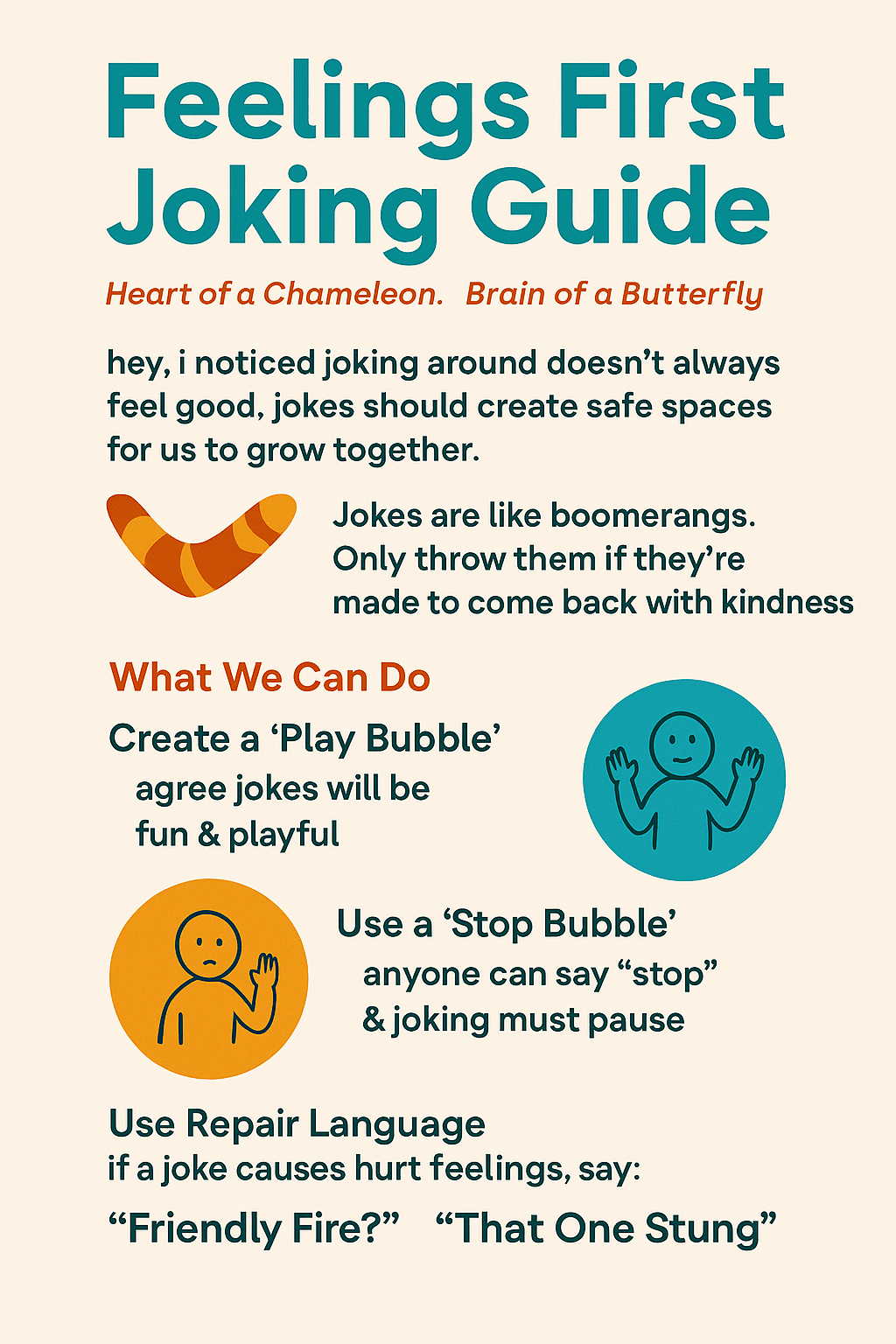
  • 🧠Joking Shouldn’t Hurt: Helping My Son Find His Play Bubble

    By Kevin | BrainButterfly.org

    There’s a moment every neurodivergent parent recognizes.

    When a joke—meant to be playful—suddenly turns into a flood of tears.

    That moment happened with my son.

    Like many kids with ADHD and big hearts, my son is still learning the invisible social rules of joking. He tries on humor the way some kids try on shoes—seeing what fits. But when he called me a silly name and I jokingly responded back with “oh come on,” it didn’t feel silly to him. It felt like a sting. And he burst into tears.

    This is where the real learning begins—not about behavior, but about emotional safety.

    Neurodivergent kids often:

    Use joking to connect, but struggle with boundaries Don’t always recognize when a joke feels too sharp Feel deep rejection when a playful comment backfires Are incredibly empathetic—and may cry from guilt or shame

    That’s why we created the Feelings First Joking Guide—a printable, visual tool to help my son (and other kids like him) learn to recognize safe, shared humor from hurtful teasing.

    What We Taught:

    Jokes are like boomerangs. If you throw them out, they come back. Make sure they’re soft! Create a “Play Bubble.” Everyone agrees we’re being silly. Use a “Stop Bubble.” If something hurts, we pause, not punish. Have repair language. “Friendly fire?” or “That one stung.”

    📥 Download the full toolkit:

    Visual guide Stop/Play Bubble cards Joke Practice Worksheet Parent-Child Conversation Guide

    🧡 Helping my son understand his emotions is part of helping him love his whole self.

    We don’t shame the tears. We listen to them.

    ➡️ Help fund trauma-informed resources for kids like my son:

    🦋 Learn more at BrainButterfly.org

  • 🔶Getting Back Up Was the Only Backup Plan I Had

    By Kevin | BrainButterfly.org

    There was no roadmap.

    No guidebook.

    No fallback plan tucked away for when life exploded.

    From the moment I was born, life came at me fast — and hard.

    And every time I got knocked down, the same truth echoed in my nervous system:

    “Get up.”

    Not because it was safe.

    Not because it was smart.

    Not because I knew what came next.

    But because getting up was the only thing I could do.

    No cushion. No backup. Just grit.

    I didn’t rise with strategy. I rose with instinct.

    Because when life keeps stripping you bare, what’s left is truth.

    And my truth is this:

    I never stopped getting back up — because I never learned how to stay down.

    People like us — the neurodivergent, the overlooked, the ones misjudged from day one — we don’t rise to prove something.

    We rise because the system never left us a choice.

    And now?

    Now I rise on purpose.

    I get up for others.

    I speak up for my son, for every kid who doesn’t fit the mold, and for the fire I carry that no system could extinguish.

    📸 Social Media Caption (Instagram, TikTok, Facebook)

    Caption:

    I didn’t have a backup plan.

    Just a promise to myself:

    Get back up. Every damn time.

    That’s how I survived. That’s how I lead now.

    🧠🦋 #BrainButterfly #HeartChameleon #NeurodivergentStrength

  • 🧠 When the Messages Come Faster Than My Brain Can Respond

    By Kevin | BrainButterfly.org

    I read the text.

    Then I read it again.

    My brain didn’t freeze—

    it just didn’t finish loading.

    And while I sat there, trying to sort through feelings, tone, and what I even wanted to say,

    the follow-up messages rolled in.

    “???”

    “Are you ignoring me?”

    “Hello?”

    “Why won’t you answer?”

    And suddenly I wasn’t just processing the first message—

    I was drowning in five more.

    None of which I was ready for.

    This Is the Part No One Sees

    People think I’m rude. Or indifferent.

    But the truth is, my nervous system is still buffering.

    I need time.

    To breathe.

    To feel what just hit me.

    To organize my words before they come out wrong.

    But the world moves fast.

    And most people don’t have the patience to wait for my full response.

    So instead of giving a thoughtful answer, I either explode or shut down.

    What’s Really Happening

    For neurodivergent people—especially those with ADHD, autism, or trauma—

    communication isn’t always about logic. It’s about regulation.

    If my nervous system feels safe,

    I can respond with clarity.

    If it doesn’t,

    I’m stuck in freeze, fawn, or fight.

    And no amount of question marks will pull me out faster.

    What I’m Learning to Say

    “I saw your message—I just need time to respond properly.”

    “I want to reply with care, not panic.”

    “I’m not ignoring you. I’m processing.”

    It’s not about avoiding people.

    It’s about honouring how I communicate best.

    For the Ones Who Need to Hear This:

    🧠 You are not rude for needing time.

    🧠 You are not broken for being overwhelmed.

    🧠 You are not a bad friend or partner or parent.

    🧠 You’re just a human with a sensitive, beautiful brain.

    And the people who matter?

    They’ll wait for your nervous system to catch up.

    📬 Subscribe to the Nest

    Get new posts, healing graphics, and brain-based parenting tools.

    👉 Join here

    🦋 With compassion,

    Kevin